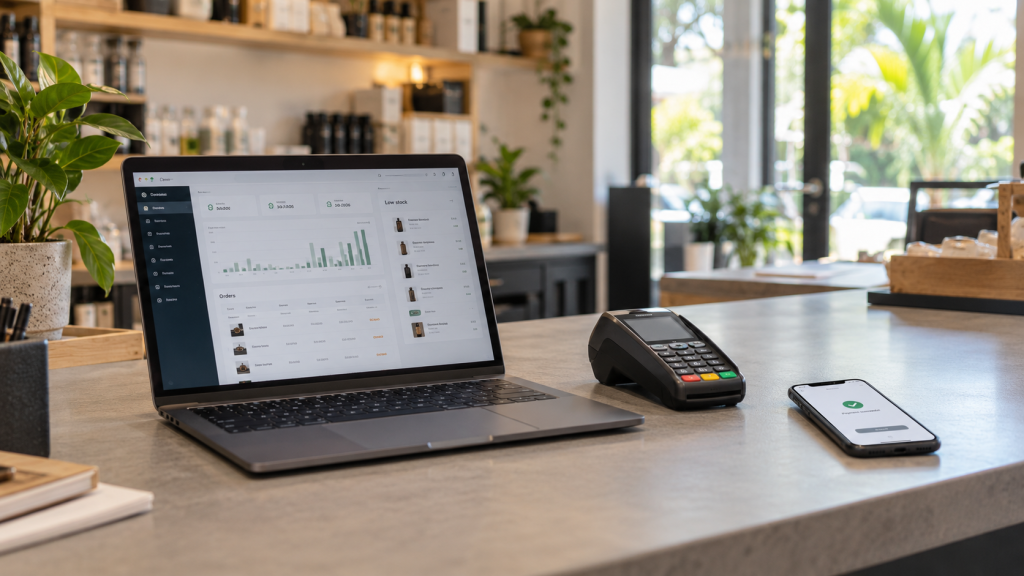
An order arrives through your website. Someone copies it into a spreadsheet. A payment comes through separately, and another person checks the bank account before updating the customer’s balance. Meanwhile, the customer sends a WhatsApp message asking for an update.
Every tool in that process might work perfectly well. Yet moving information between them still depends on someone remembering to do it.
Before adding another app, it is worth looking at those gaps.
The Work Between the Systems
Businesses often adopt software one problem at a time. Accounting needs a platform. Sales needs a website. Staff need somewhere to track orders. Customers need a way to pay.
Over time, the business ends up with several useful tools that operate independently. Staff become responsible for keeping them aligned.
That creates work which is easy to overlook:
- Entering the same customer details in multiple places.
- Updating online stock after a sale at the counter.
- Matching payments to invoices manually.
- Answering questions because customers cannot see their order status.
- Building reports by combining exports from different platforms.
As activity grows, these handoffs consume more time and create more opportunities for mistakes. A missed update can leave staff working from different versions of the same information.
What Connected Systems Look Like
Integration means giving your existing systems a reliable way to exchange the information they need.
For a retailer, that could mean using the point-of-sale system as the source for inventory updates on an online catalogue. Staff maintain stock in one place, and the website receives those changes.
For a service business, it might mean connecting payment confirmations to customer invoices, with exceptions flagged for review.
For a logistics operation, a shipment status update could also appear in the customer’s portal, reducing the need to answer the same tracking question by phone or message.
These improvements do not always require replacing the software you already use. Sometimes the most valuable addition is a connection between two tools you already depend on.
Start With One Repeated Frustration
A useful starting point is a simple question:
Where does someone repeatedly copy, check, or chase information?
Choose one workflow and follow it from beginning to end. Identify where the information starts, who handles it, and where it needs to go.
Then establish which system should hold the authoritative record. If your point-of-sale system manages stock, for example, your website should generally receive inventory information from it. Allowing both systems to change the same figures without clear rules can introduce a different set of problems.
It is also worth asking whether every step needs to happen immediately. A customer may need payment confirmation within seconds, while an internal summary may only need to update once a day.
The goal is to make the workflow dependable at the pace the business actually needs.
A Connection Needs More Than Automation
Connecting two systems is only useful if people can trust the result.
What happens when a connection fails? If a payment notification arrives twice, will it create a duplicate entry? Can staff see which updates need attention?
These details matter as much as the successful transfer of information. A well-designed integration should make failures visible and give staff a practical way to resolve them.
Some steps should also retain human review. Refunds, unusual transactions, and sensitive changes may benefit from an approval process even when the surrounding work is automated.
Build Around the Business
At Dunmore Industrial Systems, we approach these challenges by looking at how work moves through a business: what customers do, what staff need to manage, and where information gets delayed or disconnected.
That helps determine whether the right solution is an integration, a customer portal, a focused internal tool, or a simpler process using what is already in place.
Before investing in another application, examine the handoffs between the ones you have. The next improvement may be making information entered once available everywhere it is needed.
Have a workflow that depends on repeated data entry or manual follow-ups? Talk to Dunmore Industrial Systems about connecting the pieces.